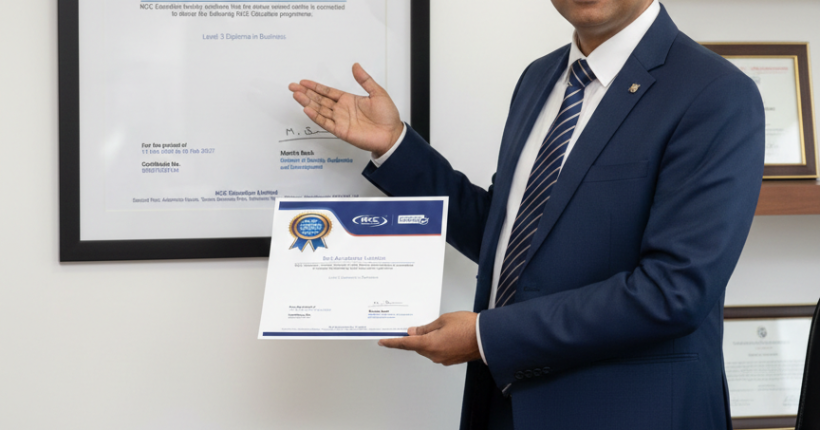
For many students, navigating the path to an international degree can be complex. NCC Education has established itself as a globally recognised awarding body that simplifies this process by offering British-standard qualifications in Business and Computing. Originally established by the British Government as a computing initiative in 1966, NCC Education is a UK awarding body and global education provider.
As an awarding organisation, we are responsible for developing, delivering, and certifying internationally recognised British qualifications in Business and IT qualifications. Our regulated curriculum ensures that our assessments are of the highest standard, providing students with the skills and knowledge required for global success.
By providing a structured, regulated framework, NCC Education enables students to complete foundational and diploma-level studies in their home countries before progressing to universities worldwide. NCC Education has developed stringent quality assurance processes to ensure that our qualifications are of high quality as standard worldwide. Our offices are located in China, Malaysia, Singapore, South Africa and the UK.
What is NCC Education?
NCC Education is a UK-based awarding organisation regulated by Ofqual (The Office of Qualifications and Examinations Regulation). Because it is government-regulated, its qualifications are listed on the UK’s Regulated Qualifications Framework (RQF).
This is crucial for global recognition: it means that an NCC Education diploma is not just a private certificate; it is an academically validated qualification that universities and employers can easily benchmark against standard UK education levels.
The Academic Progression Framework
NCC Education utilises a modular approach that mirrors the British university system, allowing for flexible entry and exit points:
- Level 3 (International Foundation): Equivalent to A-Levels or a University Foundation Year. It prepares students for undergraduate entry.
- Level 4 (Diploma): Equivalent to the first year of a UK bachelor’s degree.
- Level 5 (Advanced Diploma): Equivalent to the second year of a UK bachelor’s degree.
- Level 6 (Top-Up Degree): The final year of a degree, often completed at a partner university or online.
- Level 7 (Postgraduate Diploma): Designed for progression toward Master’s degrees.
Global Recognition and University Progression
The primary strength of these qualifications is their portability. NCC Education has established partnerships and progression agreements with over 80 universities and institutes worldwide.
NCC Education is recognised by universities, branch campuses, and professional institutions across 20+ countries worldwide, enabling international progression to undergraduate study in multiple destinations.
| Country / Region | Recognised Universities & Institutions |
|---|---|
| Australia | • Central Queensland University • Curtin University • La Trobe University • Southern Cross University • Swinburne University of Technology • The University of Queensland • The University of Western Australia • University of Canberra |
| United Kingdom (UK) | • Arts University Bournemouth • Aston University • Birmingham City University • Bournemouth University • Canterbury Christ Church University • Coventry University • Northumbria University • Nottingham Trent University • Oxford Brookes University • Royal Holloway, University of London • Sheffield Hallam University • Teesside University • University of Bath • University of Bedfordshire • University Centre Croydon • University for the Creative Arts • University of Bolton • University of Central Lancashire • University of Chester • University of Derby • University of East Anglia • University of East London • University of Essex • University of Exeter • University of Gloucestershire • University of Greenwich • University of Leicester • University of Northampton • University of Nottingham • University of Plymouth • University of Reading • University of Salford • University of Staffordshire • University of Sunderland • University of SussexUniversity of the West of England (UWEBristol)• University of Westminster • University of Worcester • University of York • Aberystwyth University • Bangor University • Swansea University • University of South Wales |
| Canada | Ascenda School of Management Fraser International College Lakeland University, Thompson Rivers University University Canada West University of New Brunswick York University, |
| China | Xi’an Jiaotong–Liverpool University |
| Cyprus | University of Nicosia Medical School |
| France | Grenoble Ecole de Management, |
| Germany | IUHB International University of Applied Sciences, |
| Hong Kong | University of Sunderland in Hong Kong, |
| Ireland | Limerick Institute of Technology, National College of Ireland, |
| Japan | Lakeland University Japan, Nagoya University of Commerce and Business, Temple University Japan Campus (TUJ), Yamanashi Gakuin University – International College of Liberal Arts (iCLA), |
| Malaysia | Curtin University Malaysia, Lincoln University College Malaysia, University of Nottingham Malaysia, University of Reading Malaysia, |
| Mauritius | Curtin University Mauritius, |
| New Zealand | Massey University, Media Design School, University of Auckland, Victoria University of Wellington, |
| Scotland | Abertay University, Glasgow Caledonian University, University of Strathclyde, |
| Singapore | Curtin University Singapore, James Cook University Singapore, SIM Global Education, Singapore, Institute of Management, |
| Switzerland | César Ritz Colleges Switzerland, Culinary Arts Academy Switzerland, Hotel Institute Montreux, Swiss Hotel Management School, |
| United Arab Emirates (UAE) | Curtin University Dubai, University of Bolton Academic Centre, RAK Al Khaimah, |
| United States of America (USA) | Berkeley College, Carroll University, Eastern Connecticut State University, Heidelberg University, Lakeland University, Northwood University, Post University, Southern Oregon University, Temple University, University of Idaho, University of North Alabama, |
| Uzbekistan | Management Development Institute of Singapore (MDIS) in Tashkent, STARS International University, Turin Polytechnic University in Tashkent, Westminster International University in Tashkent, |
| Vietnam | British University Vietnam, |
| Worldwide / Professional Bodies | ACCA (Association of Chartered Certified Accountants), Universities of London (International Programmes – in country), |
Why Universities Accept These Qualifications
- Standardisation: Because the curriculum is externally moderated and quality-assured, universities have confidence in the academic rigour of the students graduating from NCC partner centres.
- Credit Transparency: The alignment with the RQF makes it straightforward for university admissions teams to grant credit exemptions (RPL – Recognition of Prior Learning).
- Bridge to Top-Up Degrees: Many universities partner directly with NCC Education to offer Top-Up degrees. This allows students to complete their final year of a degree online or at a local partner centre while receiving the degree award from a recognised UK university.
Key Benefits for Students
- Speed: By completing the Level 4 and 5 diplomas locally, students can often fast-track to a full degree in less time than traditional routes.
- Cost-Effectiveness: Studying the first two years of a degree through a local Accredited Partner Centre (APC) significantly reduces the tuition and living costs associated with studying abroad.
- Flexible Entry: With over 200 Accredited Partner Centres in more than 50 countries, students can access British education without leaving their home country until they are ready for the final degree year.